


¡Feliz cumpleaños del libro! Today’s guest author, Núria Figueras, comes to us from Spain with her lovely, allegorical picture book, The Visit,
translated by Lawrence Schimel,
and Illustrated by Spanish artist Anna Font (Eerdmans BFYR).
About the Book:
When her mother leaves the den, Little Fox expects to spend the next few hours by herself. But then she hears a knock at the door and discovers an unusual visitor…


“Affecting….A subtle counterpoint to noise and excess that makes the absence of sound a companion worth knowing.” ―Kirkus Reviews

About the Author:
Núria Figueras is the editor of the Catalan children’s magazine El Tatano. Her writing has been recognized with the Mercè Llimona and Comte Kurt prizes. The Visit is Núria’s English-language debut and has been translated into over ten other languages, including Japanese, Chinese, Turkish, Slovenian, Portuguese, and Dutch. Núria lives in Barcelona, Spain.
ED Note: Readers may recognize the English translator of The Visit, Lawrence Schimel, who has written or translated over 300 books, including 9 Kilometers and the Batchelder Honor Book Different (all Eerdmans). To learn more about his award-winning work, follow him on Bluesky @lawrenceschimel.bksy.social.
Let’s ask Núria Figueras some questions:
Inspiration
Q 1. I read that the inspiration for this beautiful allegorical story came from your own experience staying alone as a child. Were you, like Little Fox, frightened by the silence?
Núria Figueras: First of all, thank you so much for inviting me to take part in your blog! I’m really excited!
As for your question, the story of The Visit is indeed based on my own experience. To write it, I recalled the first time I was left alone at home.
I must have been around eight or nine years old, and my mother had to go out to run an errand. When she left and closed the door, the house filled with silence. I wasn’t used to silence, because there was always quite a lot of noise at home (I’m the youngest of three siblings, and there was usually the TV on, music playing, the radio, chatter…).
The silence made a strong impression on me and frightened me a little, just like the little fox. Even though it was daytime and I was in my own home—a safe place I knew perfectly—suddenly everything felt different.
Character Choices
Q 2. Was it always your plan to personify Little Fox’s visitor?
Núria Figueras: The truth is that from the very first moment I came up with the story, I imagined silence as a character. In fact, the first mental image I had was Silence knocking on the door. I immediately liked that idea, and from there I started to develop the story.
Making Silence a character allowed the fox to communicate with it and for them to interact. It was the simplest way to talk to children about this abstract concept, which can’t be seen or touched but which, I believe, we can still perceive as a presence.

translated by Lawrence Schimel (Eerdmans BFYR).
El Tatano Influences
Q 3. How does your current job as the editor of the Catalan children’s magazine El Tatano influence you when you write a children’s book?
Núria Figueras: The magazine I work for, El Tatano (www.cavallfort.cat), is aimed at children between 4 and 8 years old, and this helps me clearly understand their reading comprehension abilities and interests.
At the magazine, we work with great respect for our young readers, with the goal of helping them discover the pleasure of reading. When it comes to writing, working at the magazine has also helped me learn to be concise, to discard what is unnecessary, and to synthesize, since the texts we publish are usually very short due to limited space.
Although, judging by how long my answers in this interview are, it might not seem like it! : )
ED Note: We love your answers.
And what a delightful, kid-friendly cover!

Surprises and Discoveries
Q 4. What surprises did your illustrator, Anna Font, bring to The Visit?
Núria Figueras: All of Anna’s work was a wonderful surprise. The warm, bright colors, the sensations they convey, and above all, the way she represents silence with a single white line. As she explains, white is the absence of color, just as silence is the absence of sound.
I didn’t influence her creative process at all—I wanted her to have complete freedom. Apart from suggesting some pagination that seemed clear to me, the only thing I proposed was that, in the middle of the book, there should be a textless spread showing the silence and the fox dancing.
My surprise was that she didn’t create just one, but two—and for me, they are the most beautiful in the entire book! These illustrations, among others, have been exhibited at the Bratislava Illustration Biennial (2025). Anna has great artistic sensitivity and has received numerous illustration awards. She was also recently selected for the Illustrators Exhibition at the Bologna Book Fair

translated by Lawrence Schimel (Eerdmans BFYR).
Q 5. Were there any surprises or discoveries as this project went from idea to published book?
Núria Figueras: For me, the biggest surprise has been seeing how a personal experience and a seemingly simple theme like silence have resonated so deeply with people from so many different countries. The Visit has been translated into fifteen languages, which suggests that we all need moments of silence, of true solitude and introspection.
We live in a time of great confusion and constant external stimuli. Our lives—and sometimes our children’s lives as well—are too stressful. We are always surrounded by noise, words, and people. We find it difficult to be alone doing nothing.
It has also been a great surprise that the book has received prestigious international awards, such as the Compostela Prize for Picture Books, convened by the publishing house Kalandraka (www.kalandraka.com), the Fundación Cuatrogatos Award, and that it has been included in the White Ravens list.
Takeaways
Q 6. What do you hope readers will take away from reading The Visit?
Núria Figueras: I would like children, after reading the story, to see silence as something positive—as a friend that allows us to relax and, at the same time, connect with our thoughts. I would like to convey that being with oneself, in the company of silence, is pleasant.
When we are alone and in silence, we can listen to what we feel, reflect, and even find moments for creativity. I believe that if we learn from an early age to feel comfortable being alone, we will discover that we can be good company for ourselves. And only if we are at ease with ourselves can we be at ease with others.

translated by Lawrence Schimel (Eerdmans BFYR).
Did we mention the Bonus Educator Guide?–>Click here!
Q 7. Please tell us about your other projects in the works.
Núria Figueras: A short humorous story has just arrived in bookstores about the adventures of Volamunt, a superhero who faces everyday problems (his flying cape shrinks in the washing machine!).
It’s a text designed to encourage independent reading for children aged six and up, and it is illustrated by Christian Inaraja , a highly talented illustrator with a distinctive style, capable of being both funny and tender at the same time.
Soon, a picture book titled The Path will also be released, with wonderful illustrations by Sebastià Serra. I wrote it right after The Visit, and in it I explore the opposite situation: the feelings I had the first time I left home on my own.
In addition, I am working on a collection of stories featuring a mother and her child as protagonists, who experience everyday situations with a touch of magical realism.


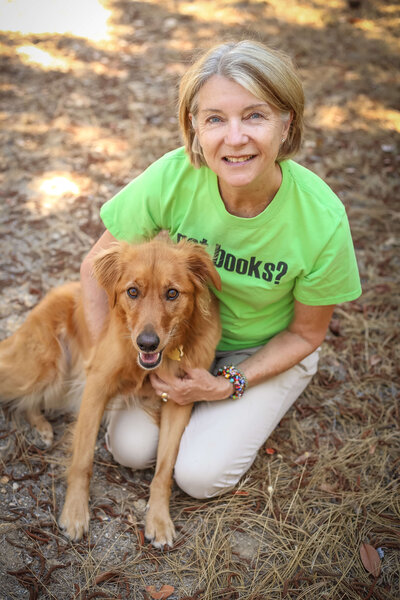
Núria Figueras and Kira: When I saw the little fox in the story, it reminded me of Kira, my dog. Although, as you can see, she doesn’t have such a long tail!
Many thanks to Núria Figueras for joining us on the blog today.
And Happy Book Birthday to the English-language debut of The Visit.
To learn more about Núria Figueras, check out her website: www.nuriafigueras.com
Next up on the blog: We chat with Jake Lockett about his new picture book,

My Life as an Asthmanaut
illus. Adriana Predoi (Free Spirit).
Comments Off on ¡Feliz cumpleaños del libro! = Happy Book Birthday to The Visit + Seven Qs with #kidlit author Núria Figueras + BONUS Educator Guide!
No comments on this post yet.