
Happy Friday, Book Friends. It’s a Bonus Book Birthday for a book about books!
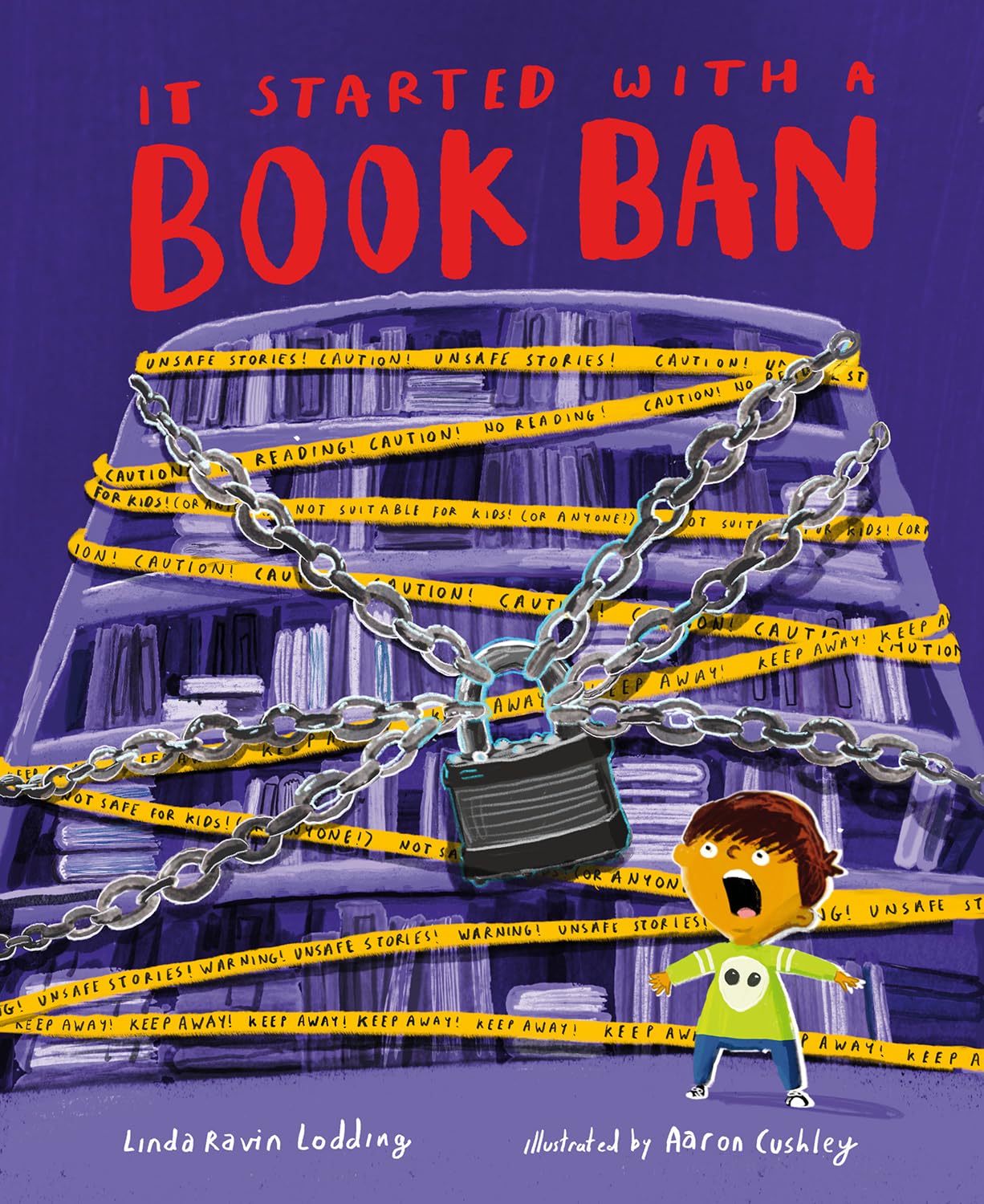
You read that correctly. Today we’re celebrating the Book Birthday of It Started with a Book Ban
by Linda Ravin Lodding,
illus. Aaron Cushley (Albert Whitman.)
About the Book:
When a book gets banned, what comes next? It’s just the beginning when Edwin finds out that all the books about outer space and planets have been banned from his library. Before long, the town starts banning all kinds of other things too–from singing birds to the color green! Oh no! As the town grows more and more miserable with each new ban, it’s up to Edwin and his friends to find a solution.
About the author:
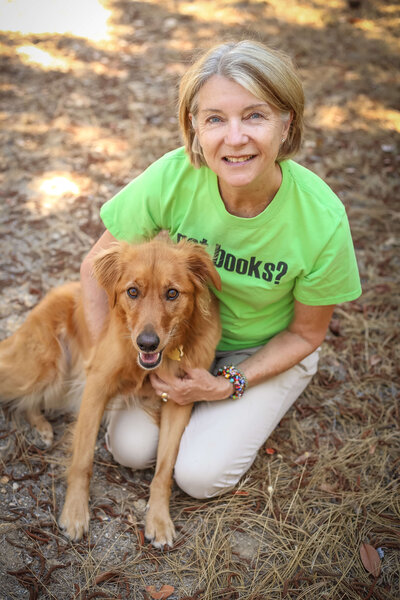
Linda Ravin Lodding is an award-winning children’s author who believes picture books can be a warm hug, a bright flashlight, and a good giggle—especially when the world feels a little too loud. She’s has eleven published picture books – with two more on the way — including The Busy Life of Ernestine Buckmeister, A Gift for Mama, Painting Pepette, Flipflopi: How a Boat Made from Flip-Flops Is Helping to Save the Ocean, and Babies Are Not Bears.
She was born in New York City, and at an early age, learned to read upside down! She now lives in Stockholm, Sweden, where she leads communications for a Royal Foundation championing children’s rights. Linda is also a writing coach who has helped over 100 picture book writers find their storytelling voice, and she founded the Stockholm Children’s Writers and Illustrators Network (a Facebook community open to all.)
She has a sweet tooth for cupcakes, a camera always at the ready, and a suitcase that’s rarely fully unpacked. And she is especially thankful for the English Bookstore, her neighborhood hangout, where books are always within reach.
ED Note/ Fun Fact: I am half-Swedish, thanks to my mother’s side of the family, so I am extra thrilled Linda was able to join us all the way from Stockholm. Isn’t it cool how books connect us?

Let’s ask some questions:
A Different Beginning…
Q 1. How did It Started with a Book Ban… start? What was the catalyst for the dominoes that led to the creation of your story?
LRL: Thank you so much for welcoming me into your writing world and for the wonderful questions — they were a joy to sit with.
The origin story for this book is actually a little different from most of mine. Usually, I begin with a character, a spark of an idea or a news story I can’t stop thinking about. But in this case, it was my editor, Josh Gregory at Albert Whitman, who approached me and asked whether I’d be interested in exploring the theme of book banning in a picture book.
The Challenge

Josh had also edited my book When We Had to Leave Home, illus. Anna Aronson, which is about a girl, her mother, and grandmother forced to flee their home during war, so he knew I’m drawn to stories that help children engage with real issues in age-appropriate ways. And I do love a writing challenge!
Challenge Accepted!
I started turning the topic around in my mind, asking myself: how do you make something as serious and unsettling as book banning accessible for children? I played with several different approaches and pitched a few treatments to Josh. Happily, we both fell for the same one.
The idea grows…
What interested me most was the absurdity of banning ideas in the first place. So in the story, once a book is banned, the townspeople begin banning all sorts of other things too — birdsong, the color green, even the letter S. Which means Starstruck Crunch cereal turns into Tartruck Crunch cereal, and best friend Sophie becomes… Ophie!
Through humor and exaggeration, I wanted to invite children into the conversation in a way that feels playful, but still thought-provoking.
At its heart, the book isn’t about telling children what to think. It’s about encouraging them to ask questions: Who gets to decide what others can read, say, or experience? And what happens when fear starts making those decisions? My hope is that it opens the door to conversation, curiosity, and tolerance.
Illustration Surprises
Q 2. What surprises did your illustrator, Aaron Cushley, bring to the project?
LRL: One of the joys of writing picture books is that you hand the story over to an illustrator and suddenly it comes back bigger, richer, funnier, and more layered than you imagined. Aaron absolutely did that.
Color Palette
When I write, I write very visually — almost cinematically. That’s one of the reasons I’m so drawn to picture books in the first place. In this form, the visual storytelling is just as important as the words, and in It Started with a Book Ban, that was especially true because the color palette is such an important part of the story.

It All Started with a Book
written by Linda Ravin Lodding, (Albert Whitman).
The book begins on a perfectly normal day: sunshine pouring into Edwin’s house, birdsong drifting in through the breakfast window, all the little details of a bright, lively world. But then, as the town starts banning things — beginning with the color green — that world slowly starts to lose its joy.
Its warmth. Its color. The town recedes from vibrant, expressive hues into shades of gray, and it was so important to me that readers would not just understand that change, but actually see it and feel it.

written by Linda Ravin Lodding, (Albert Whitman).
Aaron understood that beautifully. He captured that emotional shift in such a striking and unusual way. I’ve honestly never seen a picture book with quite such a distinctive color palette. It does so much of the storytelling on its own. And then, on top of that, he brought so much visual humor to the book.
Illustration Details
There are all these delicious little details tucked into the illustrations. One of my favorite spreads is the wall of posters announcing what’s being banned — everything from popping bubble wrap to apple pie. That kind of visual wit adds so much delight to the reading experience. Aaron really understood how to balance the book’s deeper emotional arc with silliness, charm, and surprise, and I love him for that.

written by Linda Ravin Lodding, (Albert Whitman).
Banned Books in Sweden?
Q 3. Since you live in Sweden, can you share how Swedes deal with the issue of book banning?
LRL: Sweden has such a rich children’s literature tradition, with literary icons such as Astrid Lindgren and Elsa Beskow and, more recently, Pija Lindenbaum whose books challenge sexual stereotyping.

Astrid Lindgren (the creator of Pippi Longstocking), especially, understood that children’s stories can be funny, imaginative, and full of wonder while still making room for the harder parts of life. She didn’t shy away from big feelings or difficult topics. (In fact, she lived just around the corner from me in Stockholm, so I like to think I feel her presence from time to time!).
I think that tradition has helped shape a culture that places a high value on children’s access to books and ideas. Sweden now marks Banned Books Week, which shows that freedom to read is very much part of the conversation here.
But, at the moment, there isn’t the same large national movement around book banning that we’re seeing in the U.S. Instead, these conversations tend to happen more at the local level — in schools, libraries, and communities — and usually take the form of discussion rather than removal.
That’s something I really value. The instinct here is more often, “let’s talk about this,” than, “let’s make it disappear.” And when we trust children with stories — even complex ones — we also trust them with empathy, imagination, and the chance to think for themselves.
Takeaways
Q 4. What do you hope readers will take away from reading It Started with a Book Ban?
LRL: More than anything, I hope readers come away laughing at first — and thinking just a little deeper afterward.
I hope children see that ideas matter, stories matter, and questions matter. I hope they understand that books can open doors rather than close them, and that reading lets us step into other people’s worlds with empathy and imagination.
I also hope the book gives families, teachers, and librarians a way into a conversation that can sometimes feel overwhelming. This is a big subject, but picture books are wonderful that way — they can hold big ideas in small hands.
And perhaps most of all, I hope children feel empowered to stay curious. To ask why. To wonder who decides. To notice when something doesn’t feel fair. That kind of curiosity is powerful. It’s where thoughtful readers — and thoughtful citizens — begin.
Tack så mycket
(Thank you very much)
to Linda Ravin Lodding for joining us on the blog today.
And Happy Book Birthday to It Started with a Book Ban!
To learn more about Linda, check out her website: www.lindalodding.com
And follow her on social media:
Facebook: https://www.facebook.com/LindaRavinLoddingAuthor
And a Happy Birthday to Linda from the #KidlitAriesBirthdayClub!
Next up on the blog: We celebrate the Book Birthday of The Visit

an absolutely gorgeous book by Nuria Figueras,
translated by Lawrence Schimmel, illus. Anna Font (Eerdmans BFYR)
Comments
No comments on this post yet.